Hey, I want to share something that happened to me recently about ASL meaning in text. I was chatting with a friend when I suddenly saw this term pop up, and honestly, I had no clue what it meant at first.
I kept thinking, “Am I missing something here?” It felt a bit confusing, and I didn’t want to respond the wrong way.
So, I decided to look into ASL meaning in text and understand its meaning and context. After learning, I realized how important it is to know these abbreviations to avoid awkward situations in conversations.
I handled it by learning the proper meaning and responding confidently, and now I feel prepared whenever I see ASL meaning in text again in chats, WhatsApp, Instagram, or TikTok.
Meaning & Definition
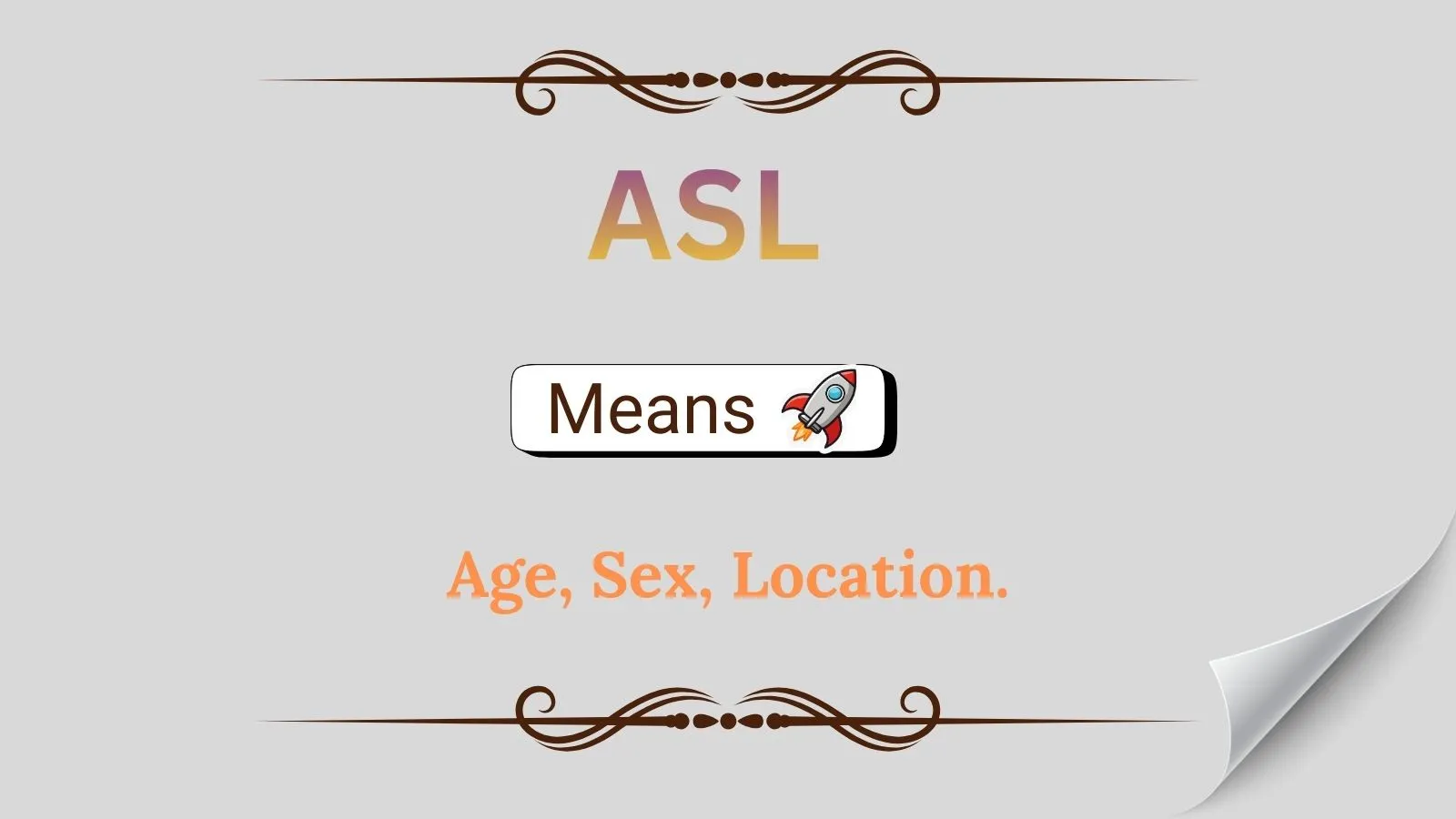
The abbreviation ASL stands for Age, Sex, Location. It is primarily used in online chats and instant messaging to quickly ask someone for basic personal details.
For example, if someone types “ASL?” they are essentially asking: “How old are you, what is your gender, and where are you from?”
While ASL is mostly casual, it’s a shorthand that saves time during conversations in chat rooms, social media platforms, and messaging apps.
The term has been around since the early days of the internet and continues to be relevant in texting culture today.
Background
ASL originated in the 1990s during the era of Internet Relay Chat (IRC) and early online forums.
Back then, people from around the world would connect anonymously, and asking for age, sex, and location became a quick way to understand who they were talking to.
Over time, ASL migrated to instant messaging services like MSN Messenger, AOL Chat, and eventually social media platforms like Facebook, Instagram, and TikTok.
The abbreviation became a cultural staple, particularly among younger users and people interested in online socializing or dating.
Its longevity shows the internet’s preference for concise, easy-to-type questions that facilitate quick introductions.
Usage in Different Contexts
Chat, WhatsApp, Instagram, TikTok
In modern digital communication, ASL is most commonly used in casual conversations:
- Chat rooms & WhatsApp: People type “ASL?” when initiating a conversation with strangers or friends they want to know better.
- Instagram & TikTok DMs: It can appear in direct messages when users are curious about the other person’s basic info.
- Gaming & forums: Gamers or forum members may use it to identify fellow players’ demographics quickly.
Professional Fields
While ASL is rarely used in formal professional communication, it can appear in informal networking chats or social platforms connected to work.
In professional contexts, asking for age, sex, or location is often replaced by more polite phrasing to respect privacy and boundaries.
Meaning in Physics, Medical, and Aircraft Terminology
Interestingly, ASL can mean completely different things in specialized fields:
- Physics: ASL may refer to Above Sea Level, commonly used in geographic and aviation contexts.
- Medical: ASL can stand for Arterial Spin Labeling, a technique in medical imaging, particularly MRI.
- Aviation & Aerospace: ASL is often shorthand for Above Sea Level, referring to altitude.
It’s crucial to understand the context to interpret ASL correctly.
Common Misconceptions
Many people mistakenly think ASL only relates to online dating or casual flirting. While it’s often used that way, ASL is simply an inquiry about basic information and can be completely neutral.
Another misconception is confusing ASL with American Sign Language, which shares the same abbreviation but is unrelated in texting contexts.
Similar Terms & Alternatives
Other acronyms similar to ASL include:
- A/S/L: An older variant spelling of ASL.
- HBL (How Big, Location): Less common and sometimes used in gaming.
- NSL (Name, Sex, Location): Rare, but similar purpose.
These alternatives have mostly fallen out of mainstream use, but they appear occasionally in retro chatrooms or online roleplaying forums.
How to Respond to It
If someone asks “ASL?” in a chat, the simplest approach is to answer honestly but briefly:
- Example: “25, Female, New York”
Alternatively, you can politely decline to provide personal info if you’re uncomfortable, which is common in public forums and social media.
Differences from Similar Words
It’s important not to confuse ASL with:
- A/S/L: Essentially the same meaning, just with slashes.
- American Sign Language: A completely different meaning unrelated to texting.
- IRL (In Real Life): Refers to offline contexts, while ASL is about personal details online.
Understanding these distinctions prevents awkward miscommunications.
Relevance in Online Conversations & Dating Apps
ASL remains relevant in online communities, dating apps, and social platforms where quick introductions are standard.
It reflects internet culture’s need for brevity and efficiency while helping users identify compatible conversation partners.
Despite its age, it is still a useful shorthand for both casual and semi-serious digital interactions.
Conclusion:
The abbreviation ASL—short for Age, Sex, Location—has a long history in internet communication.
From its origins in early chat rooms to its current presence on social media, it continues to help people quickly exchange basic personal information.
Understanding asl meaning in text is essential for anyone navigating online conversations, dating apps, or casual chats.
While it may have different meanings in professional, medical, or aviation contexts, its core use in texting is straightforward and practical.
By knowing how to use it and respond appropriately, you can communicate more confidently and avoid confusion, ensuring smooth digital interactions in any online environment.

I’m Ethan Wallace, author at GrammarsGuide.com, where I create simple, clear, and helpful grammar content.
I use my expertise to make complex English rules easy to learn and apply in everyday writing.