Some experiences resist language.
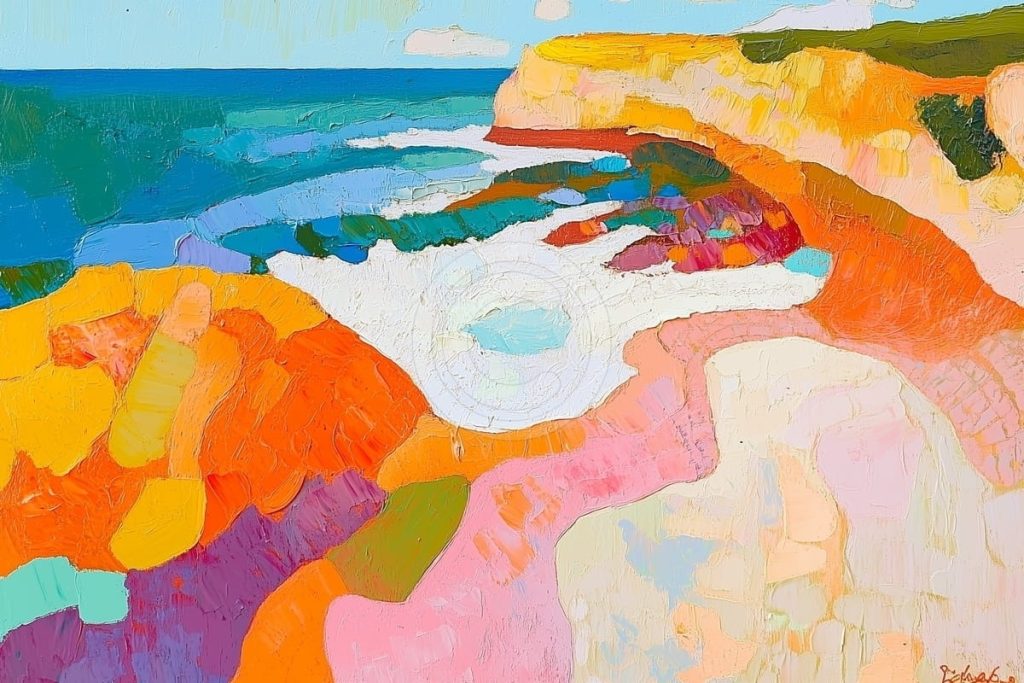
You stand before an abstract painting — layers of colour bleeding into one another, textures that seem to breathe, forms that suggest without defining — and something happens inside you. A feeling arises that is specific, recognisable, and completely real. You know exactly what you are experiencing. And yet, if someone asks you to describe it, the words available in English feel inadequate. Flat. Too small for what you are carrying.
This is not a failure of vocabulary. It is a recognition that certain human experiences are so precise, so particular, that only specific languages — shaped by specific cultures and specific ways of being in the world — have found words for them.
Here are twenty such words. Each one names something you have almost certainly felt standing before a work of abstract art. And each one, once learned, will change the way you look — and the way you understand what looking does to you.
1. Mono no Aware (物の哀れ) — Japanese
Etymology: Mono — things; no — of; aware — pathos, sensitivity Meaning: The bittersweet awareness of impermanence — the gentle sadness of beautiful things passing
Abstract paintings age. Their colours shift subtly over decades. The hand that made them is gone or will be. Mono no aware is what you feel when beauty and transience arrive together — which, in front of a great abstract canvas, they almost always do.
2. Saudade — Portuguese
Etymology: From Latin solitas — solitude, longing Meaning: A deep, melancholic longing for something loved and lost — or perhaps never possessed
Certain abstract paintings produce saudade without depicting anything that could logically cause it. A field of deep blue. A horizon suggested by a single horizontal stroke. Something in the colour reaches into you and finds a longing you had forgotten was there.
3. Wabi-Sabi (侘寂) — Japanese
Etymology: Wabi — rustic simplicity; sabi — the beauty of age and wear Meaning: The beauty found in imperfection, incompleteness, and the marks of time
Abstract painting is full of wabi-sabi — in the drip that was not corrected, the brushstroke that shows its own hesitation, the texture of paint that has cracked slightly at the edges. These are not flaws. They are the evidence of process, of time, of a human hand that was not a machine.
4. Weltschmerz — German
Etymology: Welt — world; Schmerz — pain Meaning: A deep sadness about the inadequacy of the world — the pain of comparing what is with what could be
Some abstract paintings carry weltschmerz in their bones — dark, heavy, layered canvases that seem to hold the weight of everything that has gone wrong. Rothko’s darkest works produce this feeling. So does Kiefer’s. It is not depression. It is a kind of aching lucidity.
5. Hiraeth — Welsh
Etymology: Untraceable to a single root — uniquely Welsh in its full sense Meaning: A homesickness for a home you cannot return to — or one that never existed
Abstract art frequently evokes hiraeth — a longing for a place or a state of being that you cannot name or locate. The painting suggests something familiar without depicting anything recognisable. You feel you have been here before, in this colour, in this light. You have not. And yet.
6. Forelsket — Norwegian
Etymology: From forelske — to fall in love Meaning: The euphoria of falling in love — that first overwhelming rush before it settles into something quieter
The first encounter with a painting that will matter to you for the rest of your life produces forelsket. It is unmistakable — a quickening, a sudden alertness, the sense that something important is happening. Abstract art produces it more reliably than almost any other form, because it bypasses the intellect and goes directly to the emotional centre.
7. Toska — Russian
Etymology: Slavic root — untranslatable in its full depth Meaning: A spiritual anguish — a vague restlessness, a longing with nothing to long for
Nabokov wrote that at its deepest, toska is a sensation of great spiritual anguish, often without specific cause. Certain abstract paintings — particularly those in the tradition of Russian constructivism or the darker end of Abstract Expressionism — produce this feeling: a restlessness, a reaching, a dissatisfaction that is itself a form of aliveness.
8. Mamihlapinatapai — Yaghan
Etymology: From the Yaghan language of Tierra del Fuego Meaning: A look shared between two people, each wishing the other would initiate something they both desire but neither will begin
This word describes, with uncanny precision, the relationship between a viewer and a challenging abstract painting. You stand before it. It seems to wait. Something is being offered. Something is being asked. Neither of you moves first. The looking itself becomes the exchange.
9. Sehnsucht — German
Etymology: Sehnen — to yearn; Sucht — addiction, yearning Meaning: An inconsolable longing for something just out of reach — a deep craving for an alternative state of being
C.S. Lewis called sehnsucht “the inconsolable longing in the human heart for we know not what.” Abstract art is perhaps the purest visual expression of this feeling — and the purest trigger for it. The painting does not show you what you long for. It simply makes you feel the longing, clearly and completely.
10. Aware (アワレ) — Japanese
Etymology: Classical Japanese — sensitivity, pathos Meaning: An empathetic sadness — feeling the emotions of the world around you as your own
Standing before an abstract canvas that was made during a period of the artist’s grief or struggle, without knowing that history, and feeling something heavy and true in the colour — this is aware. The painting’s emotion becomes your emotion. The boundary between the work and the viewer dissolves.
11. Geborgenheit — German
Etymology: From geborgen — sheltered, secure, held Meaning: The feeling of being utterly safe, warm, and held — a deep sense of belonging and security
Not all abstract art reaches for the dark. Some paintings — warm in palette, generous in texture, soft in their internal rhythms — produce geborgenheit: the feeling of being held by something larger than yourself. The right abstract canvas in a room can make the entire room feel like this.
12. Duende — Spanish
Etymology: Possibly from dueño de casa — lord of the house; associated with a spirit or demon Meaning: A mysterious power that a work of art has to deeply move its audience — a dark, irrational force of authentic emotion
Federico García Lorca wrote at length about duende — the quality in art that is not skill, not beauty, but something wilder and more dangerous: the presence of death, of real feeling, of authentic risk. Abstract painting at its most powerful has duende. You recognise it immediately. It makes you slightly afraid.
13. Sprezzatura — Italian
Etymology: From sprezzare — to despise, to make light of effort Meaning: The art of making difficult things look effortless — a studied carelessness that conceals the work behind it
The gestural abstract painter who covers a large canvas in apparently spontaneous marks has sprezzatura — the finished work looks free, immediate, unconsidered. What it conceals is decades of training, thousands of hours of looking and thinking and failing. The effortlessness is the achievement.
14. Ya’aburnee (يا قبرني) — Arabic
Etymology: From qabar — grave; literally “may you bury me” Meaning: A love so profound you hope to die before the beloved — because life without them would be unbearable
This word captures what collectors feel about paintings they love deeply — original works they have lived with for years, that have become part of the texture of daily life, that they cannot imagine the house without. It sounds excessive until you have felt it. Then it sounds precise.
15. Meraki (μεράκι) — Greek
Etymology: From Turkish merak — labour of love, curiosity Meaning: Doing something with soul, creativity, and love — leaving a piece of yourself in your work
Every original abstract painting is an act of meraki. The artist left something irreplaceable in the canvas — not just skill and intention but a piece of their inner life, their particular way of seeing, their specific experience of being alive at a specific moment. This is what separates an original painting from a reproduction. The meraki cannot be copied.
16. Fernweh — German
Etymology: Fern — far; Weh — ache, pain Meaning: An ache for distant places — a longing for somewhere you have never been
Abstract landscapes — or abstract paintings that suggest landscape without depicting it — frequently produce fernweh: a sudden, physical desire to be somewhere else, somewhere vast and open and unknown. The painting becomes a window not onto a specific place but onto the idea of elsewhere.
17. Koi No Yokan (恋の予感) — Japanese
Etymology: Koi — love; yokan — premonition, presentiment Meaning: The sense, upon meeting someone, that falling in love is inevitable — not love itself, but its certain approach
You see a painting across a gallery. You have not yet reached it. But you already know. This is koi no yokan — the premonition of a feeling that has not yet fully arrived but whose arrival is certain. It happens with art as reliably as it happens with people.
18. Época — Spanish (in its deeper, cultural sense)
Etymology: From Greek epokhē — a pause, a fixed point in time Meaning: A period so distinctive in its feeling that it becomes almost a place — a time you can return to through art
Great abstract paintings are time capsules of época — they carry inside them the particular feeling of the moment in which they were made. A canvas from 1950s New York feels different from one made in 1920s Paris, not because of what is depicted but because of what is held in the colour and the gesture. Art preserves época the way nothing else can.
19. Won (恩) — Korean
Etymology: Classical Korean — grace, indebtedness, deep gratitude Meaning: A profound sense of gratitude for something given freely — a grace that cannot be repaid
Standing before an abstract painting that moves you deeply, made by a human being you will never meet, offered into the world without conditions — this is won. A gift that asks nothing in return. Art, at its best, is always this.
20. Chrysalism — English (neologism)
Etymology: Coined by John Koenig in The Dictionary of Obscure Sorrows; from chrysalis — the cocoon stage of transformation Meaning: The amniotic tranquillity of being indoors during a thunderstorm — the feeling of being safely enclosed while something powerful moves outside
This word — young, newly minted, already widely felt — describes the particular comfort of standing in a quiet gallery before an abstract painting while the world continues its business outside. The painting holds you. The outside world recedes. You are, for a moment, inside the chrysalis. Something is changing. You are not yet sure what.
What These Words Tell Us About Art
Twenty words from fifteen languages — and every one of them describes something you have felt, or will feel, standing before a painting that matters.
The fact that so many cultures developed specific vocabulary for these experiences is not a curiosity. It is evidence. Evidence that the encounter between a human being and a work of art — particularly an abstract work, which offers no narrative to hide behind — is one of the most significant experiences available to us. Significant enough to name. Significant enough to pass down through generations in a single, irreplaceable word.
English, for all its extraordinary richness, does not have words for all of these feelings. But the feelings exist. They are real, they are universal, and they are waiting — in front of the right painting — to be felt again.
If you are ready to find the painting that produces your own untranslatable feeling, exploring original handmade abstract works is the place to begin. PastelBrush brings together original canvas paintings made by hand — each one carrying the meraki, the duende, and the quiet human presence that makes abstract art not merely decorative but genuinely transformative. Browse the abstract paintings collection and pay attention to what you feel. The word for it may not exist in English. But you will know it when it arrives.