Have you ever needed to process a PhilHealth transaction but couldn’t visit the office yourself? Life happens. Sometimes you’re sick, busy at work, out of town, or dealing with family responsibilities. In these situations, asking someone you trust to handle your PhilHealth concerns can be a lifesaver.
This is where an authorization letter for PhilHealth becomes important.
Many Filipinos are unaware that certain PhilHealth transactions can be processed by an authorized representative. However, the representative usually needs proper documentation, including a valid PhilHealth authorization letter, to act on your behalf.
The good news is that creating one isn’t complicated. A simple and properly written authorization letter can save time, reduce stress, and help ensure your healthcare benefits, records, or membership concerns are handled smoothly.
In this guide, you’ll learn everything about a PhilHealth authorization letter, including its purpose, requirements, format, sample templates, and common mistakes to avoid.
What Is an Authorization Letter for PhilHealth?
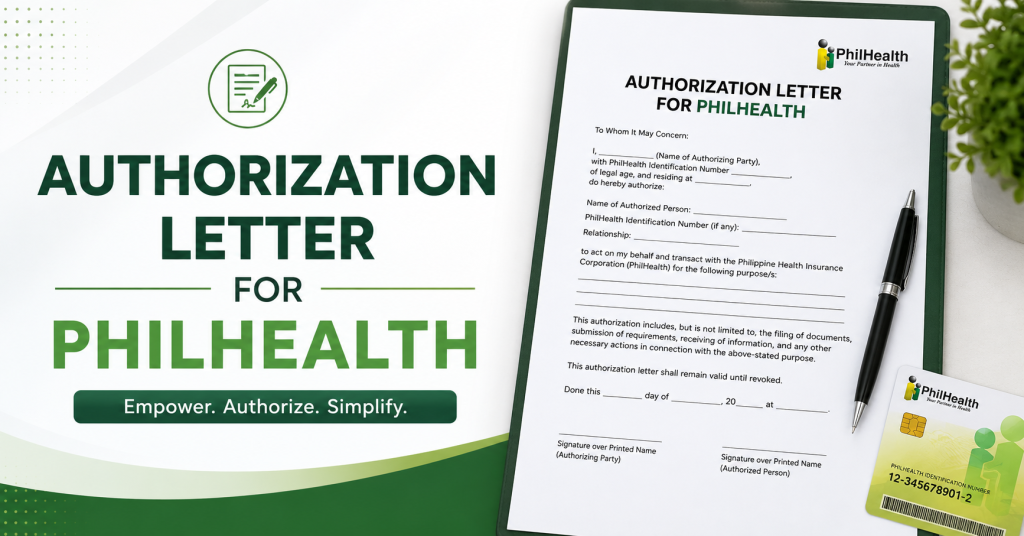
An Authorization Letter For PhilHealth is a written document that grants another person permission to perform a PhilHealth-related transaction on your behalf.
The person giving permission is called the principal, while the person receiving permission is known as the authorized representative.
This letter serves as proof that the representative has your consent to handle specific tasks such as:
- Claiming benefits
- Updating member information
- Requesting records
- Submitting documents
- Processing membership concerns
- Receiving PhilHealth documents
- Following up on claims
A properly written PhilHealth representative authorization letter helps protect both the member and PhilHealth by clearly stating who is authorized and what actions they may perform.
Reasons for Using an Authorization Letter in PhilHealth Transactions
There are many situations where a PhilHealth authorization letter becomes necessary.
Medical Emergencies
Patients who are hospitalized or recovering from illness may not be physically capable of visiting a PhilHealth office.
An authorized representative can process claims and submit requirements on their behalf.
Work Commitments
Many employees find it difficult to visit government offices during working hours.
Instead of taking leave from work, they can authorize a trusted family member.
Living Abroad
Overseas Filipino Workers often need assistance handling PhilHealth matters while outside the country.
A representative can manage necessary transactions in the Philippines.
Senior Citizens
Some elderly members have mobility challenges and may prefer letting a family member process their PhilHealth concerns.
Distance and Travel Limitations
Not everyone lives near a PhilHealth branch.
An authorization letter can help reduce travel expenses and save valuable time.
Requirements for a PhilHealth Authorization Letter
Before preparing a PhilHealth authorization letter sample, make sure you have the required information.
Generally, the letter should include:
Full Name of the Member
Write your complete legal name exactly as it appears on official records.
PhilHealth Identification Number
Include your PhilHealth ID number whenever applicable.
Full Name of the Authorized Representative
Clearly identify the person who will act on your behalf.
Specific Purpose
State exactly what transaction the representative is authorized to perform.
Date
The authorization letter should indicate the date it was written.
Signature
The member’s signature is one of the most important requirements.
Supporting Identification
Valid government-issued IDs are often required for both parties.
In some situations, PhilHealth may request additional supporting documents depending on the transaction.
How to Write an Authorization Letter for PhilHealth
Many people overcomplicate the process. In reality, writing a simple authorization letter for PhilHealth is straightforward.
Follow these steps:
Step 1: Write the Date
Place the current date at the top of the letter.
Step 2: Add a Proper Greeting
Address the letter respectfully.
Example:
“To Whom It May Concern”
Step 3: Introduce Yourself
State your complete name and PhilHealth number.
Example:
“I, Juan Dela Cruz, holder of PhilHealth Identification Number XXXXXXX, hereby authorize…”
Step 4: Identify Your Representative
Include the full name of the person you’re authorizing.
Step 5: State the Purpose
Clearly explain what transaction they may process.
For example:
- Claim benefits
- Submit documents
- Update records
- Request membership information
Step 6: Confirm Authorization
Explicitly state that the representative has your permission.
Step 7: Sign the Letter
Affix your signature above your printed name.
Standard Authorization Letter Format for PhilHealth
A standard PhilHealth authorization letter format typically follows this structure:
- Date
- Recipient
- Subject Line (optional)
- Introduction
- Authorization Statement
- Purpose of Authorization
- Closing Statement
- Signature
- Printed Name
- Contact Information
Keeping the format simple and professional improves readability and acceptance.
Tips for Creating a Valid PhilHealth Authorization Letter
A small mistake can delay your transaction. Here are some practical tips.
Be Specific
Avoid vague statements.
Instead of saying:
“Handle my PhilHealth concerns”
Write:
“Submit my PhilHealth claim documents and receive claim updates.”
Use Complete Names
Always use legal names rather than nicknames.
Match ID Information
The names in the authorization letter should match the names on valid IDs.
Include Contact Details
Providing a phone number can help officials verify information if necessary.
Keep the Letter Clear
Simple language is often more effective than complicated wording.
Attach Supporting Documents
Prepare photocopies of valid IDs and other required records.
Double-Check Before Submission
Review spelling, dates, and identification numbers.
A few extra minutes can prevent unnecessary delays.
Common Mistakes to Avoid
Even experienced individuals sometimes make mistakes when creating a PhilHealth authorization letter.
Missing Signature
A letter without a signature may be considered invalid.
Incorrect Personal Information
Wrong names, identification numbers, or contact details can create processing issues.
Unclear Purpose
PhilHealth staff should easily understand what the representative is authorized to do.
Illegible Handwriting
If writing by hand, ensure everything is readable.
Using Nicknames
Always use official names appearing on government IDs.
Missing Supporting Documents
Many transactions require ID copies alongside the authorization letter.
Forgetting the Date
An undated authorization letter may cause verification concerns.
PhilHealth Authorization Letter Requirements Checklist
Authorization Letter Checklist
✔ Full name of member
✔ PhilHealth identification number
✔ Full name of authorized representative
✔ Specific transaction purpose
✔ Current date
✔ Member’s signature
✔ Contact information
✔ Photocopy of member’s valid ID
✔ Photocopy of representative’s valid ID
✔ Additional supporting documents if required
Reviewing this checklist can save significant time and effort.
Frequently Asked Questions (FAQs)
Can someone claim PhilHealth benefits on my behalf?
Yes. In many situations, an authorized representative may process certain PhilHealth transactions if they have a valid authorization letter and supporting documents.
Does PhilHealth accept handwritten authorization letters?
Generally, handwritten letters may be accepted as long as they are clear, complete, and signed by the member.
Is notarization required for a PhilHealth authorization letter?
Requirements may vary depending on the transaction. Some cases may require notarization, while others may not.
What IDs should be attached?
Government-issued IDs are commonly requested for both the member and the authorized representative.
Can a family member serve as my representative?
Yes. Many members authorize spouses, siblings, children, parents, or trusted relatives.
Can I use one authorization letter for multiple transactions?
It depends on the specific transaction and office requirements. Clearly listing all authorized actions can help avoid confusion.
How long is an authorization letter valid?
Validity depends on the purpose and any date limitations specified in the document.
Can an authorization letter be typed?
Yes. Typed authorization letters are often preferred because they are easier to read.
Conclusion
A well-written authorization letter for PhilHealth can make life much easier when you cannot personally handle your membership concerns, claims, or document requests. Whether you’re recovering from illness, working overseas, caring for family, or simply facing scheduling conflicts, authorizing a trusted representative provides a practical solution.
The key is to keep the letter clear, accurate, and complete. Include all necessary details, use official names, attach supporting IDs, and clearly describe the purpose of the authorization.
Although the process may seem minor, a properly prepared PhilHealth authorization letter can prevent delays, reduce stress, and ensure your important healthcare-related transactions move forward smoothly.
Before submitting your documents, take a final look at the requirements checklist. That small step can save hours of frustration and help your transaction proceed without unnecessary complications.