Keeping students engaged has become one of the biggest challenges in modern education. Many teachers have experienced the same situation: a classroom full of students who appear physically present but mentally somewhere else. Traditional lectures and worksheets often struggle to hold students’ attention in a world filled with technology, social media, and instant entertainment.
This challenge has encouraged educators to explore new teaching methods that make learning more interactive and meaningful. One approach that continues to gain popularity is active learning. Instead of simply listening to information, students participate, think critically, solve problems, and engage with educational content in real time.
This is where Blooket has made a significant impact.
Blooket combines educational content with exciting game-based learning experiences. It transforms ordinary classroom reviews into interactive activities that students genuinely enjoy. Rather than seeing learning as a task, students often view Blooket sessions as a game they want to win.
But how exactly does Blooket support active learning in schools? And why are so many teachers incorporating it into their classrooms?
Let’s explore.
What Is Blooket?
Blooket is an educational technology platform that allows teachers to create or use question sets and turn them into engaging learning games. Students answer questions while participating in different game modes that include rewards, competition, and strategy.
Unlike many traditional educational quiz platforms, Blooket offers multiple game experiences. This variety keeps activities fresh and prevents students from becoming bored.
Teachers can:
- Create custom question sets
- Import existing quizzes
- Host live classroom games
- Assign homework activities
- Monitor student performance
- Review learning progress
Students join using a simple game code and can participate on computers, tablets, or smartphones.
The platform has quickly become one of the most popular interactive learning tools used in schools today.
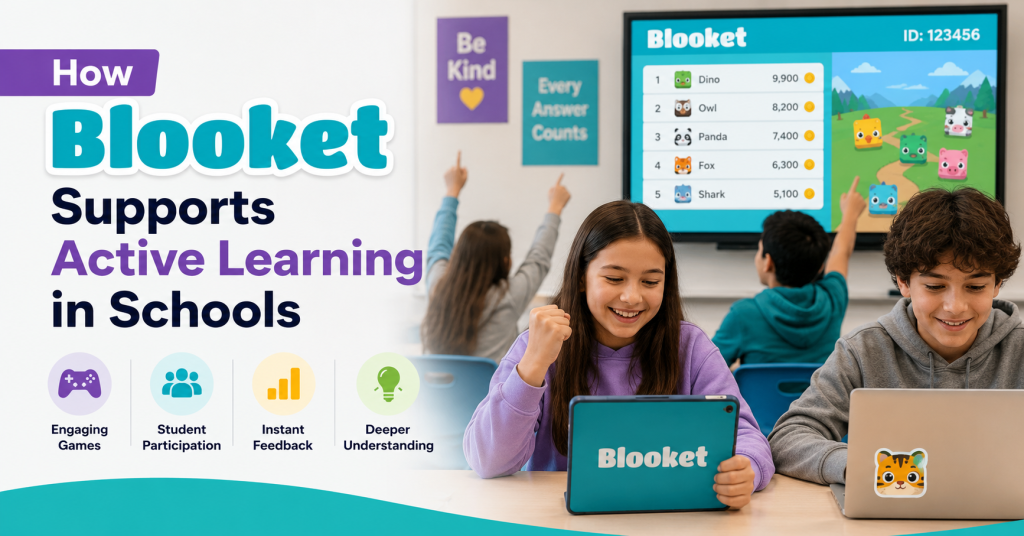
Understanding Active Learning
Before understanding how Blooket supports active learning, it’s important to understand what active learning actually means.
Active learning is an educational approach where students participate directly in the learning process rather than passively receiving information.
Instead of simply listening to a lecture, students:
- Answer questions
- Solve problems
- Discuss ideas
- Collaborate with peers
- Apply knowledge
- Reflect on learning
Research consistently shows that students learn better when they actively engage with content.
Think about it this way. Most people do not learn to ride a bicycle by reading a book. They learn by getting on the bike, making mistakes, adjusting, and trying again.
Learning works much the same way.
Active learning encourages students to become participants rather than spectators.
How Blooket Encourages Student Participation
One of the biggest strengths of Blooket is its ability to increase student participation.
Many students hesitate to answer questions during traditional classroom discussions. Some fear making mistakes, while others simply lack confidence.
Blooket changes this dynamic.
The game environment creates a lower-pressure setting where participation feels natural. Students become focused on progressing through the game rather than worrying about whether their answer is perfect.
Several features encourage engagement:
Instant Feedback
Students immediately know whether their answers are correct. This quick feedback helps reinforce learning and keeps students engaged.
Friendly Competition
Competition often motivates students to participate more actively. The desire to earn points, unlock rewards, and improve rankings encourages consistent involvement.
Variety of Game Modes
One common problem with educational software is repetition. Blooket avoids this by offering multiple game styles that keep learning exciting.
Individual Participation
Every student answers questions rather than relying on a few volunteers. This creates a more inclusive learning environment.
Ways Blooket Supports Active Learning in Schools
Blooket actively promotes student-centered learning in several important ways.
Encourages Critical Thinking
Students must process information quickly and make decisions during gameplay. This keeps their minds actively engaged with lesson content.
Reinforces Knowledge Through Practice
Repetition plays an important role in learning. Blooket allows students to review concepts multiple times without making the process feel repetitive.
Promotes Learning Through Games
Game-based learning has become increasingly important in modern education. By combining learning objectives with gameplay mechanics, Blooket makes review sessions more enjoyable.
Increases Classroom Interaction
Students interact with content continuously rather than waiting passively for instruction.
Supports Formative Assessment
Teachers can quickly identify learning gaps and adjust lessons accordingly. This helps improve classroom assessment practices and student outcomes.
Motivates Reluctant Learners
Students who normally avoid participation often become more involved when learning feels fun and interactive.
Benefits of Blooket for Teachers
Teachers face increasing pressure to keep students engaged while meeting educational goals. Blooket offers several advantages that make classroom management easier.
Saves Preparation Time
Teachers can use existing question sets or create new ones quickly.
Provides Useful Performance Data
Detailed reports help teachers understand student strengths and weaknesses.
Increases Classroom Engagement
Engaged students are generally easier to manage and more likely to retain information.
Supports Different Teaching Styles
Whether a teacher prefers direct instruction, collaborative learning, or review-based activities, Blooket can complement various approaches.
Makes Assessment Less Stressful
Students often view Blooket activities as games rather than tests, reducing anxiety while still providing valuable assessment data.
Benefits of Blooket for Students
Students often respond positively to Blooket because it transforms learning into an enjoyable experience.
Makes Learning Fun
Let’s be honest. Students are more likely to engage when learning feels entertaining.
Builds Confidence
Frequent participation and immediate feedback help students gain confidence in their abilities.
Improves Knowledge Retention
Interactive learning experiences often lead to better memory and understanding.
Encourages Student Motivation
Game rewards and progress systems create incentives that encourage continued participation.
Supports Personalized Learning
Students can learn at their own pace in assigned activities and homework modes.
Blooket Across Different Subjects
One reason Blooket has become so popular is its flexibility.
Mathematics
Teachers can create quizzes focused on calculations, formulas, and problem-solving skills.
Science
Students can review scientific concepts, vocabulary, and experimental procedures.
Language Arts
Blooket works well for grammar practice, reading comprehension, and vocabulary development.
Social Studies
Historical events, geography, government systems, and cultural topics can be transformed into engaging review activities.
Foreign Languages
Language teachers often use Blooket to strengthen vocabulary recognition and language comprehension.
This versatility makes Blooket valuable across virtually every subject area.
Blooket in Remote and Hybrid Learning
The rise of remote learning highlighted the need for engaging digital classroom tools.
One major challenge of virtual education is maintaining student attention. Without face-to-face interaction, students can easily become distracted.
Blooket helps solve this problem by creating interactive online learning activities that encourage participation.
Teachers can:
- Host live virtual games
- Assign independent learning activities
- Track student progress remotely
- Maintain engagement outside the classroom
For hybrid learning environments, Blooket provides a consistent experience for both in-person and remote students.
Real Classroom Examples of Active Learning With Blooket
Imagine a sixth-grade science teacher reviewing ecosystems.
Instead of handing out a worksheet, the teacher launches a Blooket game. Students answer questions about food chains, habitats, and environmental interactions.
As the game progresses, students remain focused, discuss answers with classmates, and become excited about improving their scores.
In another classroom, a history teacher uses Blooket before an exam. Students review important historical events through competitive gameplay. Rather than memorizing facts passively, they actively engage with the material.
These examples demonstrate how active learning classroom games can transform ordinary review sessions into meaningful educational experiences.
Challenges and Limitations
While Blooket offers many benefits, it is not perfect.
Overemphasis on Competition
Some students thrive in competitive environments, while others may feel pressured.
Potential Distractions
Students may focus more on winning than on learning if activities are not carefully structured.
Technology Requirements
Reliable internet access and compatible devices are necessary.
Not a Complete Teaching Solution
Blooket works best as a supplement rather than a replacement for comprehensive instruction.
Teachers should balance game-based activities with discussions, projects, reading, and other learning methods.
Best Practices for Using Blooket in Schools
To maximize educational value, teachers should follow several best practices.
Align Games With Learning Objectives
Every activity should support specific educational goals.
Rotate Game Modes
Changing formats helps maintain student interest.
Review Results After Gameplay
Discussing answers and misconceptions reinforces learning.
Keep Questions Clear
Simple, well-written questions improve the learning experience.
Encourage Positive Competition
Competition should motivate rather than discourage students.
Use Data to Improve Instruction
Performance reports can guide future lesson planning.
Blooket vs Traditional Learning Methods
Traditional learning methods often rely heavily on lectures, note-taking, and worksheets.
These approaches can be effective, but they sometimes struggle to maintain student attention.
Blooket offers a different experience.
| Traditional Learning | Blooket |
| Passive participation | Active participation |
| Limited interaction | High interaction |
| Delayed feedback | Instant feedback |
| Lower engagement | Higher engagement |
| Static activities | Dynamic game modes |
This does not mean traditional methods should disappear. Instead, Blooket works best when combined with proven teaching practices.
The most effective classrooms often blend traditional instruction with interactive learning tools.
The Future of Active Learning With Blooket
Educational technology continues to evolve rapidly.
As schools increasingly adopt digital learning tools, platforms like Blooket will likely play a larger role in modern education.
Future developments may include:
- Enhanced analytics
- More customization options
- New game modes
- Improved accessibility features
- Better integration with classroom systems
The demand for engaging learning activities is unlikely to disappear. Students continue to respond positively to interactive experiences that make education feel meaningful and enjoyable.
Because of this, Blooket appears well-positioned to remain an important part of classroom gamification and active learning strategies.
Frequently Asked Questions
Is Blooket free to use?
Yes. Blooket offers a free version that includes many useful features for teachers and students.
How do students join a Blooket game?
Students simply enter a game code provided by their teacher and choose a character before starting.
Can Blooket be used for homework?
Yes. Teachers can assign games that students complete independently outside class.
Is Blooket suitable for all grade levels?
Blooket can be adapted for elementary, middle school, high school, and even some higher education settings.
Does Blooket improve student engagement?
Many teachers report increased classroom participation and enthusiasm when using Blooket regularly.
Can Blooket be used in remote learning?
Absolutely. It is widely used in virtual and hybrid learning environments.
Conclusion
Blooket has become much more than just another educational game platform. It represents a shift toward active learning, student engagement, and interactive classroom experiences.
By combining educational content with game-based learning, Blooket encourages participation, supports classroom assessment, and makes learning more enjoyable for students. Teachers benefit from improved engagement and valuable performance insights, while students gain opportunities to practice, compete, and learn in a low-pressure environment.
No educational tool is perfect, and Blooket should not replace strong teaching practices. However, when used thoughtfully, it can become a powerful addition to modern classrooms.
As education continues to embrace digital innovation, platforms like Blooket are helping schools create learning environments where students are not just present—they are actively involved, motivated, and excited to learn.