When moving to France, studying at a French university, applying for residency, getting married, or completing an administrative procedure, foreign documents often need to be translated into French. However, not every translation is accepted by French authorities.
Understanding how to translate official documents for France can help avoid delays and ensure that your documents meet the requirements of the administration, university, court, embassy, or other institution receiving them.
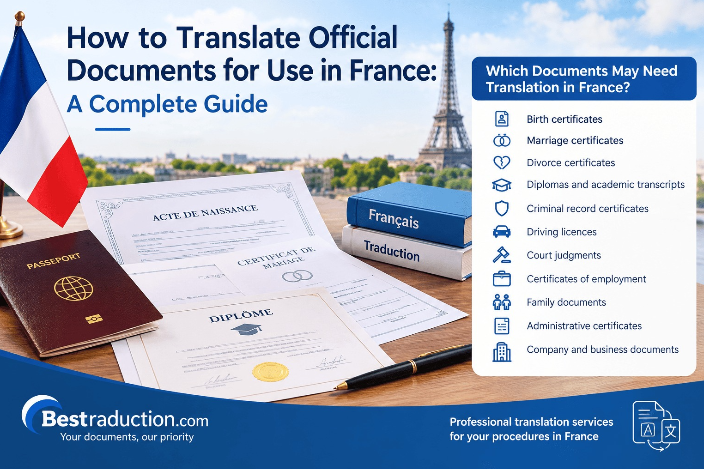
Which Documents May Need Translation in France?
Many types of foreign documents may need to be translated into French, depending on the procedure and the authority requesting them.
Common examples include:
- Birth certificates
- Marriage certificates
- Divorce certificates
- Diplomas and academic transcripts
- Criminal record certificates
- Driving licences
- Court judgments
- Certificates of employment
- Family documents
- Administrative certificates
- Company and business documents
The exact requirements depend on the purpose of the application and the institution concerned. Before ordering a translation, it is therefore advisable to check whether the receiving authority requires a standard translation or a sworn translation.
What Is a Sworn Translation?
A sworn translation is an official translation prepared by a translator who has the required authorization or recognition for the relevant jurisdiction.
For procedures involving French authorities, certain documents may need to be translated by a translator whose work is recognized for official purposes. The translation may include the translator’s signature, stamp, certification statement, and other identifying information.
The term used and the exact requirements can vary depending on the country where the translator is authorized and the French authority receiving the document.
This is why applicants should verify the requirements of the specific administration before submitting their documents.
When Is a Sworn Translation Required?
A sworn translation may be requested when a foreign document is being submitted as part of an official procedure.
For example, a sworn translation may be relevant for:
Immigration and Residency
Foreign civil-status documents, certificates, and other official records may need to be translated when applying for a residence permit or completing an immigration procedure.
Education
Students applying to French universities or educational institutions may be asked to provide French translations of diplomas, transcripts, certificates, or other academic records.
Marriage and Civil Status
Foreign birth certificates, marriage certificates, divorce documents, and family records may need to be translated for certain civil-status procedures in France.
Legal Procedures
Courts, lawyers, and other legal institutions may require translated versions of foreign judgments, legal certificates, contracts, or other documents.
Employment and Professional Procedures
Professionals moving to France may need translations of diplomas, professional qualifications, certificates, or employment-related documents.
How to Prepare Your Documents for Translation
Before sending a document to a translator, make sure that the document is complete and clearly readable.
A few simple steps can make the process easier:
1. Check the original document
Make sure that names, dates, numbers, stamps, and other important information are visible.
2. Identify the receiving authority
Find out which organization will receive the translated document. Requirements may differ between administrations, universities, courts, and other institutions.
3. Check whether a sworn translation is required
Do not automatically order a standard translation if the procedure specifically requires a sworn or certified translation.
4. Ask about additional formalities
Depending on the document and country of origin, additional procedures such as legalization, authentication, or an apostille may sometimes be required.
5. Confirm the delivery format
Some procedures may require a paper document, while others may accept a digital certified version. Confirm this before placing your order.
Why Accuracy Matters in Official Translation
Official documents contain information that must be reproduced accurately. A small error in a person’s name, date of birth, identification number, qualification, or place of birth can cause difficulties during an administrative procedure.
A professional translator should pay particular attention to:
- Names and surnames
- Dates and places
- Official terminology
- Document numbers
- Stamps and seals
- Signatures and annotations
- Academic qualifications
- Legal terminology
The goal is not simply to translate individual words. The translator must accurately communicate the information contained in the original document while respecting the terminology and conventions of the target language.
Can a Foreign Document Be Translated From a Scan?
This depends on the translator and the requirements of the procedure.
For an initial quotation, a clear scan or photograph is often sufficient. However, certain procedures may require the translator to work from the original document or may impose specific requirements concerning the format and authenticity of the source document.
It is therefore important to provide the translator with a clear copy and explain how the translation will be used.
How Long Does an Official Translation Take?
The turnaround time depends on several factors, including the number of pages, language combination, document type, formatting, and whether the translation is required urgently.
Simple civil-status documents may generally be processed faster than lengthy legal judgments or academic files containing tables and complex formatting.
When requesting a quotation, it is useful to provide all the documents at the same time so that the translator can accurately assess the workload and estimated delivery time.
Choosing a Professional Translation Service
When an official translation is required, price should not be the only consideration. The translator’s qualifications, experience with administrative documents, language combination, delivery time, and familiarity with the requirements of the target country are also important.
BEST TRADUCTION provides professional sworn and certified translation services for individuals and organizations dealing with French administrative, academic, legal, and professional procedures.
The service covers a wide range of documents, including civil-status records, diplomas, academic transcripts, criminal records, court documents, and other official certificates.
For people who need a translation of official documents for use in France, BEST TRADUCTION can assess the documents, provide a quotation, and explain the appropriate translation process.
Final Checklist Before Submitting Your Documents
Before submitting a translated document to a French authority, check the following:
- Is the document complete and clearly readable?
- Is the translation in French?
- Does the procedure require a sworn or certified translation?
- Is the translator appropriately qualified or recognized for the procedure?
- Are names, dates, and document numbers correct?
- Are additional formalities such as legalization or an apostille required?
- Does the receiving authority accept the format you intend to submit?
Taking a few minutes to verify these points can help prevent avoidable problems.
Conclusion
Translating an official document for use in France involves more than converting text from one language into another. The type of translation, the translator’s qualifications, the document format, and the requirements of the receiving authority can all be important.
Whether you are preparing an immigration application, enrolling at a French university, completing a civil-status procedure, or dealing with a legal matter, checking the translation requirements in advance can make the process considerably easier.
By choosing an experienced professional and providing complete information about the intended use of the document, applicants can ensure that their translations are prepared appropriately for their French administrative procedures.