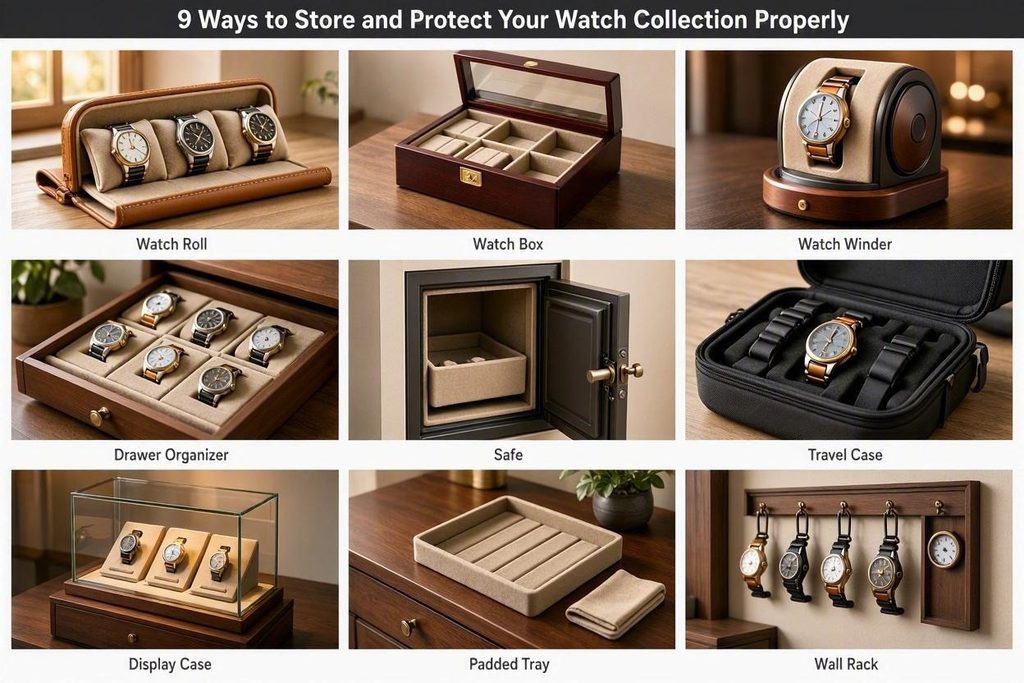
Buying a beautiful automatic watch is only half the job. What happens to it when it’s sitting in a drawer, packed for a trip, or waiting on a shelf between wears matters just as much as how it performs on your wrist. A watch that’s stored carelessly can pick up scratches, lose its accuracy, or even seize up from a lack of movement. A watch that’s stored properly, on the other hand, can run smoothly and look sharp for decades.
If you’ve ever wondered whether you really need a watch box, whether a winder is worth the money, or how often you should actually be handling your pieces, this guide walks through the practical answers. None of it requires specialist tools or a big budget — mostly it comes down to a handful of habits that most owners simply haven’t thought about yet.
Below are nine storage habits that make a real difference, in the order most collectors should think about them.
1. Never Just Toss Your Watch in a Drawer
It’s tempting to slide a watch off your wrist and drop it into a bedside drawer at the end of the day. The problem is that loose watches knock against keys, coins, other watches, and drawer hardware, and metal bracelets and crystals scratch far more easily than people expect.
A dedicated storage solution — even something as simple as a soft pouch — creates a buffer between your watch and everything else in the drawer. It also keeps dust out of the case back and crown, which matters more than most owners realise until they open a watch that hasn’t been cleaned in years.
2. Understand the Difference Between a Watch Roll and a Watch Box
Two of the most common storage options are watch rolls and watch boxes, and they serve slightly different purposes.
A watch box is a fixed, often stackable case with individual compartments — good for a permanent collection sitting on a dresser or in a wardrobe. A watch roll is soft-sided, compact, and designed to travel. It wraps around each watch individually, cushioning the case and crystal, and takes up a fraction of the space a hard box would in a suitcase.
If you split time between home and travel, or you simply prefer a slimmer, more portable option, Aevitas UK Leather Watch Rolls are built specifically for that job — soft, padded compartments that keep two or more watches separated and scratch-free without adding bulk to your bag.
Leather rolls also age well, which matters if you’re using one daily. A quality leather roll develops a bit of character over time rather than wearing out, and the individual compartments mean two watches never touch each other directly, which is where most travel-related scuffs actually happen. If you’re deciding between a hard case and a roll for regular travel, the roll usually wins simply because it fits into a carry-on pocket without adding weight.
3. Keep Watches Away from Direct Sunlight and Heat
Prolonged sun exposure fades leather straps, dries out gaskets, and can even affect the lubricants inside a mechanical movement over time. Heat from radiators, car dashboards, or a windowsill display case does the same damage more quickly than people assume.
Store your collection somewhere with a stable, moderate temperature — a wardrobe, a drawer, or a display case kept out of direct light is far safer than an open shelf near a window.
4. Watch Out for Magnetism
Magnetic fields are one of the most common — and most overlooked — causes of a mechanical watch running fast or stopping altogether. Smartphones, laptop speakers, handbag magnetic clasps, and even some jewellery boxes with magnetic clasps can throw off a movement’s accuracy within seconds of contact.
Keep your watches a reasonable distance from speakers, phone cases, and anything else with a strong magnet, and if a watch starts gaining or losing several minutes a day for no obvious reason, magnetism is usually the first thing worth ruling out. The Federation of the Swiss Watch Industry is a useful reference point if you want a deeper, industry-level look at how mechanical movements are built and maintained.
5. Decide Whether You Actually Need a Watch Winder
This is the question almost every automatic watch owner asks eventually: is a winder actually necessary, or is it just a nice-to-have?
If you wear a watch daily, you probably don’t need one — normal wrist movement keeps it wound. But if you own more than one automatic watch and rotate between them, a winder saves you from resetting the time, date, and any complications every time you pick a piece back up. That’s especially relevant for watches with a perpetual calendar, where resetting the date can be a genuinely fiddly process.
Not all winders are built the same, though. Motor quality, rotation direction settings, and turns-per-day (TPD) accuracy vary a lot between brands, and a cheap unit can actually do more harm than good by over-winding a movement or running at the wrong TPD for your specific watch. It’s worth reading everything about best watch winder brands before buying one, since matching the winder to your watch’s specifications is what actually protects the movement rather than just spinning it for the sake of it.
6. Set the Right TPD and Direction for Each Watch
Every automatic movement has a manufacturer-recommended turns-per-day figure and a winding direction — clockwise, counter-clockwise, or bidirectional. Setting a winder incorrectly won’t destroy a watch overnight, but consistently over-winding or winding in the wrong direction puts unnecessary strain on the mainspring and rotor over months and years.
Most manufacturers publish this information, and it’s worth checking before you set a new watch in a winder for the first time rather than relying on a generic default setting.
7. Handle Your Watches Less Than You Think You Should
It sounds counterintuitive, but one of the best things you can do for a watch’s crystal and case finish is to simply handle it less. Every time a watch is picked up, wiped down, or repositioned in a box, there’s a small chance of a fingerprint smudge turning into a scratch from grit or dust already on the surface.
When you do need to clean a watch, use a soft, dry microfibre cloth rather than tissue or a rough fabric, and avoid pressing directly on the crystal with any abrasive material.
8. Rotate Your Collection Instead of Letting Pieces Sit Untouched
A watch that sits completely still for months at a time isn’t being damaged in any dramatic way, but its gaskets can dry out slightly and its lubricants can settle unevenly. If you own several pieces, try to wear or wind each one at least occasionally rather than letting one or two sit forgotten at the back of a drawer for a year.
This is also a good moment to give each watch a quick visual check — looking for any condensation under the crystal, a stopped second hand, or a strap that’s started to crack, all of which are easier to fix early than after months of neglect.
9. Get Advice When You’re Not Sure
Storage habits that work for a simple three-hand watch aren’t always right for a chronograph, a moonphase, or a vintage piece with an older gasket. If you’re building a collection and want it to actually hold its value and function well over time, it’s worth getting a second opinion rather than guessing.
The team at Aevitas works with collectors regularly on exactly this kind of question — from which roll or box suits a specific collection size to which winder settings match a particular movement — so reaching out before you buy storage for an expensive piece is generally time well spent.
This is especially worth doing if you’ve inherited a watch, bought something second-hand without much history, or you’re simply not sure what movement is inside a piece you already own. A quick conversation can save you from buying the wrong winder or storing a delicate vintage strap the same way you’d store a modern rubber one.
Final Thoughts
Good watch storage isn’t complicated, but it does require a bit more thought than most owners give it. Keeping pieces cushioned and separated, away from heat and magnets, wound correctly when they’re not being worn, and handled only when necessary will do more for your collection’s longevity than almost anything else you can do at home. Whether that means a soft roll for travel, a proper box for a growing collection, or a winder set up correctly for each movement, the goal is the same: let the watch do what it was built to do for as long as possible.
FAQs
Do I need a watch winder if I only own one automatic watch? Not usually. If you wear it regularly, normal wrist movement is enough to keep it wound. A winder becomes useful once you own two or more automatics and rotate between them.
Is a watch roll good enough for long-term storage, or do I need a box? A roll is excellent for travel and for smaller collections, but a box with individual compartments and a stable environment is generally better for long-term home storage of a larger collection.
How often should an automatic watch be serviced? Most manufacturers recommend a full service every three to five years, though this can vary depending on the movement and how often the watch is worn.
Can a magnet really stop a watch from working properly? Yes. A magnetised mainspring or hairspring can cause a mechanical watch to run significantly fast or stop altogether. It’s a common and often misdiagnosed issue.
What TPD setting should I use for a watch winder? It depends entirely on the movement — check the manufacturer’s specifications rather than using a generic default, since incorrect TPD or direction settings can strain the movement over time.