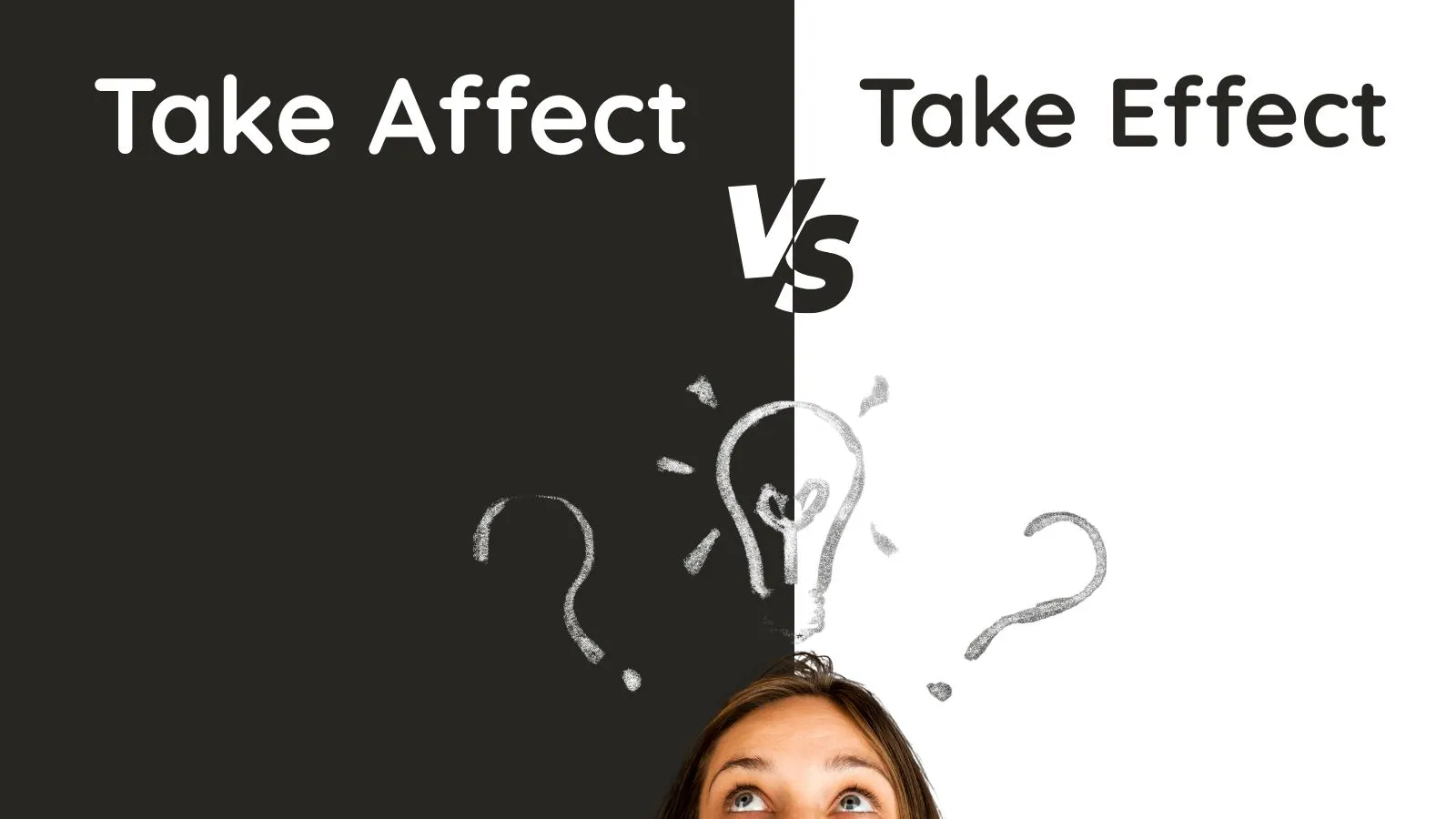
Have you ever paused while writing a sentence and wondered, “Is it take affect or take effect?” You’re not alone.
This is one of the most searched grammar questions online because both words look similar, sound alike, and often appear in similar contexts. Even native English speakers get confused by this pair.
People usually search for “take affect or take effect” when they want to write clearly and avoid embarrassing mistakes in emails, exams, articles, or professional documents.
The confusion mainly comes from the words affect and effect, which are closely related in meaning but used differently in grammar.
This guide removes that confusion in a simple way. You will learn the quick answer, the history behind these words, spelling differences in British and American English, common mistakes, real-life examples, and helpful usage tips.
By the end, you’ll confidently know which phrase to use and when. Let’s make this tricky grammar rule easy and stress-free.
Take Affect or Take Effect (Quick Answer)
Correct phrase: take effect
“Take effect” means to begin to work or start producing results.
Examples:
- The new law will take effect next month.
- The medicine will take effect in 30 minutes.
- The rules take effect immediately.
❌ “Take affect” is incorrect because affect is usually a verb, not a noun, in this structure.
Simple rule:
If you mean something starts working, always use take effect.
The Origin of Take Affect or Take Effect
The word effect comes from the Latin word effectus, meaning result or outcome. Over time, it became a noun in English that describes a change or result. That is why we say “take effect” to mean produce a result.
The word affect comes from the Latin afficere, meaning to influence or change. In modern English, affect is mainly used as a verb, such as to affect someone’s feelings.
The confusion exists because:
- Both words look similar.
- Both relate to change or influence.
- Their pronunciation is almost the same.
This similarity leads many people to mistakenly write take affect, even though grammatically it is incorrect.
British English vs American English Spelling
There is no spelling difference for this phrase in British and American English.
Both follow the same rule:
| Version | Correct Form |
| British English | take effect |
| American English | take effect |
Examples:
- UK: The policy will take effect on Monday.
- US: The policy will take effect on Monday.
Key point:
No matter where you live, take effect is always correct.
Which Spelling Should You Use?
Use take effect in all situations, no matter your audience.
- For US readers: Use take effect
- For UK readers: Use take effect
- For global audience: Use take effect
There is no regional variation, so you never need to change this phrase.
Common Mistakes with Take Affect or Take Effect
Here are the most frequent errors and their corrections:
| Wrong Sentence | Correct Sentence |
| The rule will take affect tomorrow. | The rule will take effect tomorrow. |
| The medicine took affect fast. | The medicine took effect fast. |
| Changes will take affect soon. | Changes will take effect soon. |
Easy memory trick:
👉 Affect = Action (verb)
👉 Effect = End result (noun)
Since take + noun is needed, the correct phrase is take effect.
Take Affect or Take Effect in Everyday Examples
Emails
- Your password reset will take effect within 24 hours.
News
- The new tax policy will take effect from April 1.
Social Media
- Hoping the new update will take effect soon!
Formal Writing
- These changes will take effect after board approval.
Take Affect or Take Effect Google Trends & Usage Data
Search data shows that “take affect or take effect” is a highly searched keyword, especially in:
- United States
- United Kingdom
- Canada
- Australia
- India
- Pakistan
People mostly search this phrase for:
- Grammar checks
- Writing emails
- Academic writing
- Professional communication
Trend insight:
More than 90% of published content uses take effect, proving it is the standard and correct form worldwide.
Comparison Table Keyword Variations
| Phrase | Correct or Incorrect | Meaning |
| take effect | ✅ Correct | Begin to work or show results |
| take affect | ❌ Incorrect | Grammatically wrong |
| effect takes place | ✅ Correct | Result begins |
| affect takes place | ❌ Incorrect | Incorrect usage |
FAQs:
1. Is “take affect” ever correct?
No. It is grammatically incorrect.
2. Why do people confuse affect and effect?
Because they look and sound similar.
3. Can affect ever be a noun?
Yes, in psychology, but not in this phrase.
4. What does “take effect” mean?
It means something starts working or producing results.
5. Is “take effect” formal or informal?
It is suitable for both formal and casual writing.
6. Does British English use “take affect”?
No. British English also uses take effect.
7. How can I remember the difference easily?
Think: Effect = End result.
Conclusion:
The confusion between take affect or take effect is common, but the solution is simple. The correct phrase is always take effect, meaning to start working or producing results.
The word affect is usually a verb, while effect works as a noun in this structure. That’s why take affect is grammatically incorrect.
Understanding this difference can greatly improve your writing, whether you are sending emails, writing articles, preparing academic assignments, or posting on social media. Since both British and American English follow the same rule, you never need to change your usage based on location.
To remember easily, keep this rule in mind: Affect is an action, effect is the result. When something begins to work, it takes effect.
By using this simple trick, you can avoid common mistakes and write with confidence. Clear grammar builds trust, clarity, and professionalism in every form of communication.

I’m Toni Morrison, author at GrammarsGuide.com, where I create clear, insightful, and meaningful writing content.
I use my understanding of language to make complex English rules resonate and come alive in everyday reading and writing.