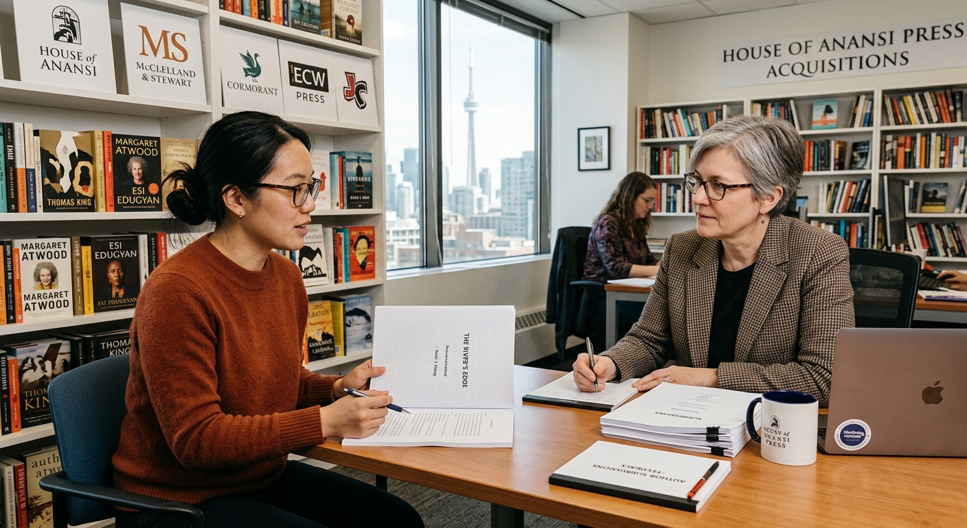
However, completion of the manuscript marks just the beginning for those hoping to get published. Many authors ask what publishers will consider when they assess manuscripts from an author they have never worked with. Even though every publisher has its own standards, there are certain aspects that can determine the fate of the manuscript.
These include quality of writing, originality, the target audience, relevance on the market, and professionalism of the submission itself.
What Do Canadian Publishers Look for in New Authors?
Typically, Canadian publishers seek out original manuscripts with excellent writing skills, concept clarity, and clear target audiences.
Before approaching a publisher, it will help if authors understand the kind of genre and purpose their book will have. For example, for fiction, the publisher will evaluate characters, plot, pace, dialogue, and narrative voice. For non-fiction, it will be about research, expertise, organization, and how useful the topic will be for readers.
An excellent idea will matter, but the manuscript needs to prove that the book belongs in a publisher’s list.
How Can Authors Improve Their Manuscripts?
The writers need to go through the entire manuscript and make necessary changes before submitting it. The fact that an initial draft has been completed does not imply that it is ready for professional evaluation.
Important considerations in the process should be:
- Introduction: Begin the story or the main topic in a proper manner.
- Writing style: Stick to appropriate tone and form.
- Uniqueness: Provide the book with a unique angle.
- Audience: Understand whom the book will appeal to.
- Formatting: Observe all the necessary rules.
- Proofreading: Get rid of all the grammatical errors and structural problems.
Why Should Authors Research Publishers Before Submitting?
The research will help the author in identifying those publishers who are right for his writing. The publishing houses specialize in different genres, topics, target readers, etc.
The author must analyze the books published by the publishers and see if their manuscript fits the same profile. The author must look at the current guidelines of submission since there are many differences among them.
Some publishers accept unsolicited manuscripts whereas some may accept manuscripts only from literary agents. Thus sending a generic submission to all publishing houses may not be a good idea.
What Should Authors Include in a Submission?
The requirements for submission may vary from one publisher to another. Yet, the author can usually be expected to provide a query letter, manuscript, synopsis, sample chapters, and an author’s bio. For non-fiction authors, there may be additional requests for details regarding the target audience, competing works, and author’s qualifications.
| Submission Element | Purpose | Focus |
| Query Letter | To introduce the book | Presentation |
| Manuscript | Writing skills | Structure |
| Synopsis | Summary of the work | Main plot/argument |
| Author Biography | Background information | Qualifications |
| Target Audience | For whom is the book intended? | Target audience |
| Comparable Titles | Market awareness | Compared books |
By following the requested format, the author demonstrates that he/she has read and understood the publisher’s requirements.
How Can New Authors Demonstrate Professionalism?
Professionalism starts from the very submission. Authors should express themselves clearly and submit all the requested material and follow the instructions.
It is necessary to proofread the text as well. If grammar or spelling mistakes happen often enough in the otherwise good text, the manuscript will look unprofessional. Sometimes, professional editing services could be considered for manuscripts that require major structural and linguistic improvements.
Authors should also be patient. Publishing houses receive lots of manuscripts, so it takes time before receiving a response. Being rejected does not mean that the manuscript has no potential. It might just not match the current list of the publishing house.
What Makes a New Author’s Book Stand Out?
Originality can aid the manuscript in catching the eye. It does not mean that the topic has to be entirely new. The usual topic can make a difference through a unique approach, solid research, practical knowledge, or compelling writing.
Fiction writers can also use interesting characters and a great narrative to make a story better. Nonfiction writers can rely on expertise, research, and valuable insights to make their concept attractive.
However, it is necessary to conduct research on similar works too. Knowledge of existing books will help in proving the differences in the manuscripts.
Why Is Knowing the Target Audience Important?
Identification of a proper target audience aids in knowing the intended readers of the book. Stating that a book is intended for everyone does not give much information.
The authors should identify the readers from various aspects including age, hobbies, occupation, education level, or other special needs. The information might be helpful to the positioning of the book.
If the author knows the intended reader of his/her book, he/she will easily communicate its usefulness.
How Does an Author’s Experience Matter?
The experience of an author is especially helpful in non-fiction and specialist topics. Professional experience, education, work experience, research or expertise can establish authority.
Writers of fiction do not always require professional credentials. In such situations, the book under consideration comes first.
An existing audience can be helpful in certain books. Professional connections, website, community or any other way of establishing potential audience can be helpful, though it is not necessary to have lots of social media followers.
What Should Authors Do After Completing a Manuscript?
Once the manuscript is complete, authors need to revise, proofread, and clarify the structure of their work. Then, it is time for authors to conduct research on publishers by genre, subject, catalog, and submission policies.
The next step is to provide all the required materials to the publishers and not give any unnecessary information.
It is helpful for authors to know about traditional and independent publishing. The former provides editorial and distribution help, while the latter provides authors more freedom.
For writers comparing their options, researching book publishing Canada services can help them understand available professional support and evaluate which publishing route may suit their project.
How Can Authors Choose the Right Publishing Path?
Authors need to analyze different types of publication in relation to their needs, budget, timeframe, and desired amount of control. Traditional publishing is selective and may offer professional industry support; independent publishing gives more control, but requires the author to handle much of the process himself.
There is also digital publishing. Kindle Direct Publishing, for instance, allows qualified authors to self-publish books in digital and print format via Kindle and its networks.
Which way works best is up to the book and the writer. It’s always helpful to do some research first.
Explore Professional Publishing Options
Authors considering professional publishing support can research available services, compare what providers offer, and understand the publishing process before selecting a suitable option.
Conclusion
New writers can make their chances of publication more favorable by ensuring that their writing is of high caliber, innovative, audience-oriented, well-researched, and professionally prepared. Well-prepared material helps publishers have a better idea of the book.