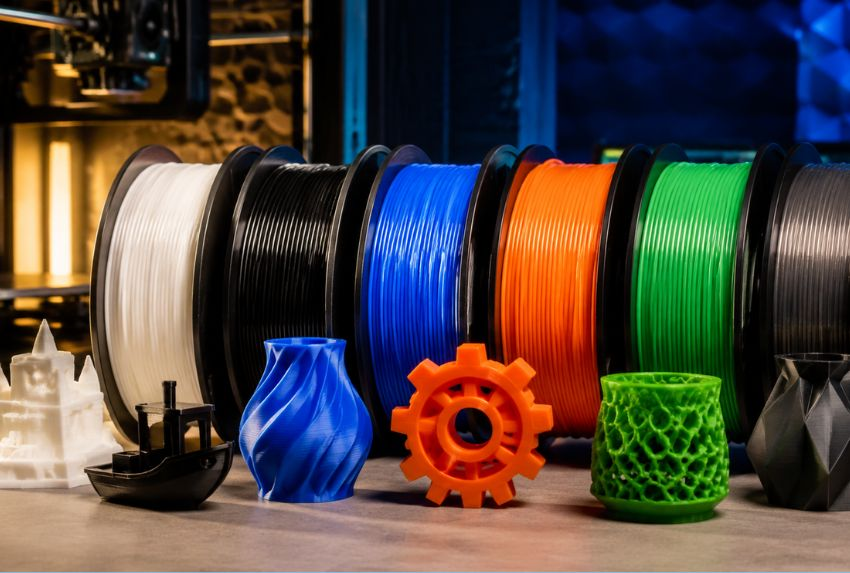
Many operators spend weeks researching hardware specifications and fine-tuning slicing parameters, only to grab the cheapest spool of plastic available when it is time to manufacture a part. This is a fundamental error. The physical characteristics of your final object—its tensile strength, thermal resistance, impact absorption, and flexibility—are entirely dictated by the chemistry of the raw material.
Loading the wrong plastic guarantees structural failure, regardless of how precise the hardware kinematics are. A perfectly calibrated machine cannot stop a poorly chosen material from melting in a hot car or shattering under physical impact. To move from printing basic trinkets to manufacturing functional, load-bearing parts, you must understand the distinct chemical profiles of the materials available and apply them to the correct engineering scenarios.
Choosing the Right Filament for Strength, Detail, and Durability
The desktop manufacturing market offers dozens of different plastics, but the vast majority of projects can be executed flawlessly by mastering four core material categories. Understanding the thermal limits and mechanical behaviors of these plastics allows you to match the material to the physical demands of the object.
1. PLA (Polylactic Acid): The Detail Specialist
PLA is the default material for desktop fabrication, and for good reason. It is a plant-based, biodegradable thermoplastic that melts at a relatively low temperature and experiences almost zero shrinkage as it cools. This lack of thermal contraction means parts printed in PLA stay flat on the build plate and retain extremely sharp, precise geometric details.
However, PLA has severe mechanical limitations. It is exceptionally stiff, meaning it does not bend or yield under stress; it simply shatters. More importantly, it has a very low glass transition temperature (around 60°C).
- Best Use Cases: High-detail architectural models, tabletop miniatures, cosmetic prototypes, and indoor decorative items.
- When to Avoid: Anything exposed to direct sunlight, automotive interiors, or mechanical assemblies that endure heavy impact or friction. If you print a car phone mount in PLA, it will permanently deform on the first warm summer day.
2. PETG (Polyethylene Terephthalate Glycol): The Functional All-Rounder
If you need a part to survive outside of a climate-controlled room, PETG is the standard upgrade. It takes the ease of printing associated with PLA and combines it with the durability of more industrial plastics. PETG is naturally water-resistant, possesses a higher thermal resistance (surviving up to 80°C without deforming), and offers significant mechanical flex. When struck heavily, a PETG part will bend and absorb the kinetic energy rather than snapping.
When building a material library, ensuring you have high-quality filament like PETG on hand covers the vast majority of functional household repairs and outdoor projects. The primary drawback of PETG is its tendency to string; the molten plastic is extremely sticky, requiring aggressive retraction settings to prevent spiderweb-like strands across your models.
- Best Use Cases: Snap-fit joints, outdoor plant pots, liquid containers, structural brackets, and drone frames.
- When to Avoid: Models with highly complex, microscopic details or parts that require extensive sanding, as PETG’s chemical resistance makes it notoriously difficult to paint or smooth.
3. ABS and ASA: The High-Temperature Workhorses
Acrylonitrile Butadiene Styrene (ABS) and its UV-resistant sibling, Acrylic Styrene Acrylonitrile (ASA), are engineering-grade plastics. These materials are heavily utilized in traditional injection molding (like Lego bricks and automotive dashboards) because they offer exceptional toughness, impact resistance, and a heat deflection temperature near 100°C.
Manufacturing with these materials requires specific hardware. ABS and ASA shrink violently when exposed to room-temperature air. If you attempt to process them on an open-frame 3D printer, the bottom of the part will cool faster than the top, causing the object to warp and rip itself off the build plate. Successfully printing these plastics requires a fully enclosed, heated build chamber and adequate ventilation, as they emit volatile organic compounds (VOCs) during the melting process.
- Best Use Cases: Engine bay components, outdoor fixtures exposed to year-round weathering (specifically ASA), mechanical gears, and tools subject to high friction.
- When to Avoid: Large, flat prints on unenclosed machines, or printing in unventilated living spaces.
4. TPU (Thermoplastic Polyurethane): The Flexible Alternative
TPU breaks the rule that manufactured parts must be rigid. It is a highly elastic material capable of bending, stretching, and compressing without losing its original shape. TPU is categorized by its “Shore Hardness”—a 95A TPU feels like a stiff shopping cart wheel, while an 85A TPU feels like a soft rubber watch band.
Printing TPU requires a direct-drive extrusion system. Because the material is literally rubber, attempting to push it through a long Bowden tube results in the plastic buckling and jamming the gears.
- Best Use Cases: Custom gaskets, shock-absorbing bumpers, tires for RC cars, wearable electronics housings, and flexible hinges.
- When to Avoid: Models that require rigid structural support, or designs with extreme overhangs, as TPU cannot be easily bridged or supported by standard breakaway structures.
A Practical Workflow for Material Selection
Before slicing a file and sending it to the machine, run the project through a strict environmental and mechanical assessment. Ask yourself these four questions:
- Will the part be exposed to elevated temperatures? If the part will sit in a hot car, near a radiator, or house hot electronic components, eliminate PLA immediately. Default to PETG for medium heat or ABS/ASA for high heat.
- Will the part live outdoors? UV radiation from the sun breaks down the chemical bonds in standard plastics, making them brittle over time. For outdoor fixtures, ASA is the absolute best choice, followed closely by PETG.
- Will the part endure impact or repeated flexing? Rigid materials like PLA will crack under sudden stress. For living hinges, snap-fit buckles, or protective bumpers, use PETG for semi-rigidity or TPU for pure shock absorption.
- Does the part require post-processing? If your goal is a visually flawless prop that needs to be sanded, primed, and painted, PLA and ABS are the best candidates. They sand easily and accept acrylic paints well, whereas PETG repels most adhesives and paints.
Conclusion
Mastering desktop fabrication means moving beyond a one-size-fits-all mentality. Your hardware is simply the delivery mechanism; the plastic you choose dictates the real-world viability of the object. By stocking your workspace with specific materials tailored to distinct environments—PLA for pristine detail, PETG for everyday mechanical stress, ABS/ASA for high-heat engineering, and TPU for flexibility—you transition from printing fragile prototypes to manufacturing permanent, functional solutions. Ensure your material selection aligns with the physical reality your part will face, and your failure rate will drop dramatically.