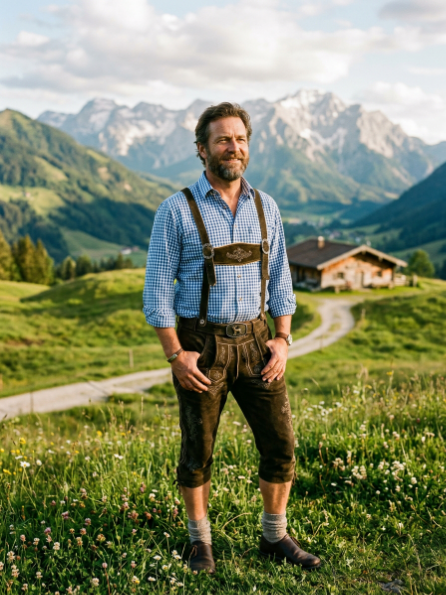
Here is the uncomfortable truth about men’s festival outfits: most that fail don’t fail at the lederhosen they fail at the shirt. The mens oktoberfest shirt covers more visible area than any other piece, frames the face in every photograph, and instantly signals whether the wearer assembled an authentic Bavarian look or grabbed a costume off a party-store rack. A $300 pair of deerskin lederhosen over a shiny polyester novelty shirt reads as costume; a $120 accessible pair over a crisp woven Trachtenhemd reads as the real thing. In 2026, with photo-heavy festival culture stronger than ever, the shirt is the highest-leverage decision in the men’s outfit.
This guide covers the style choice, the fit standards, the fabric floor you should never go below, and how the shirt slots into the complete outfit system.
The Style Choice: White Formal or Checkered Festival
Men’s Oktoberfest shirts resolve into two authentic styles, and choosing between them is choosing your register. The solid white Trachtenhemd is the formal pole: clean woven cotton, traditional collar, sometimes subtle placket or shoulder detailing. Under lederhosen it produces the most elevated configuration — correct for Bavarian weddings, formal dinners, and men who want maximum tradition in photographs.
The checkered Trachtenhemd is the festival pole and the statistical majority in every beer tent. Blue-and-white check is the Bavarian-flag classic that coordinates with all leather tones; red-and-white runs warmer and pops against dark brown; green-and-white carries Alpine hunting character. Both styles are equally authentic register, not correctness, is the decision. First-time buyers whose calendar is purely festival should take the check; anyone with a formal event ahead should own the white.
The Fabric Floor: Woven Cotton or Walk Away
Every failed shirt purchase in this category shares one root cause: fabric. The authentic standard is woven cotton or a cotton-rich blend breathable through a packed tent, matte and rich in photographs, durable across seasons of washing. The costume tier substitutes thin printed polyester, and it announces itself in three ways: it shines artificially under tent lighting, it runs hot within an hour of crowd density, and on checkered shirts the pattern is printed on one side rather than woven through both.
The fabric-reverse check is the single fastest quality screen, and the price floor confirms it: quality woven Trachtenhemden run roughly $35 to $70 in 2026. A “complete look” shirt at $15 is polyester wearing good photography.
Slotting the Shirt Into a Complete German Outfit Oktoberfest Ready
The shirt performs inside a system, and assembling the full german outfit oktoberfest ready means coordinating outward from it. The sequence is fixed: shirt tucked into the lederhosen, suspenders over the shirt with the pattern sitting calmly under the breastplate, collar open one button for festival ease or closed for formal, sleeves rolled cleanly to the forearm in warm tents and down for ceremonies.
Coordination completes it. Echo the check color somewhere small — hat band, sock trim, or a partner’s dirndl apron for couples — and keep the rest of the palette in leather neutrals. Add the wool knee socks, the Haferl-style shoes, and the Alpine hat, and the shirt’s register carries through the entire ensemble. Skip any element and the shirt’s quality can’t save the gaps; get them all and even accessible-tier pieces read cohesive and intentional.
Fit Standards Suspenders Make Non-Negotiable
Lederhosen suspenders expose fit flaws an untucked casual shirt would hide, which makes three standards non-negotiable. Shoulder seams must sit exactly at the shoulder edge — the suspender straps run right beside them and make dropped seams obvious. The body must be trim enough to tuck without ballooning; excess fabric bunches under the H-bar and destroys the clean line the outfit depends on. Length must be generous enough to stay tucked through twelve hours of standing, bench-climbing, and dancing — the constant re-tuck is the universal tell of a shirt bought too short.
Between sizes, fit the shoulders and let the tuck govern the waist. A shoulder-correct shirt photographs right from every angle the festival day produces.
The Two-Shirt Minimum for Real Festival Use
One practical rule separates experienced festival-goers from first-timers: nobody survives a multi-day event on one shirt. Beer, pretzel grease, and tent heat guarantee it. The efficient rotation is two to three shirts — one white for the formal register, one blue-and-white check as the daily workhorse, optionally one alternate check for variety — machine-washed between festival days while the leather pieces simply air out. The full rotation still costs less than a single mid-range lederhosen upgrade, and it is the difference between day three looking as sharp as day one.
Frequently Asked Questions
White or checkered for my first shirt?
Checkered blue-and-white if your calendar is festivals only; add white when a formal Bavarian occasion appears. Frequent attendees should own both.
What’s the minimum quality worth buying?
Woven cotton or cotton-rich blend, real buttons, interfaced collar — realistically $35 to $70 in 2026. Below that is polyester costume tier.
How do I verify woven versus printed check online?
Look for fabric-reverse photos or “yarn-dyed / woven check” in the specification; printed polyester shows a blank reverse side.
How should the shirt fit under suspenders?
Exact at the shoulders, trim through the body, long enough to stay tucked all day.
Does the shirt really have to tuck in?
Yes — tucked with suspenders over it is the convention; untucked is the fastest way to read costume.
How many shirts for a festival weekend?
Two minimum, three for a full week, washed in rotation.