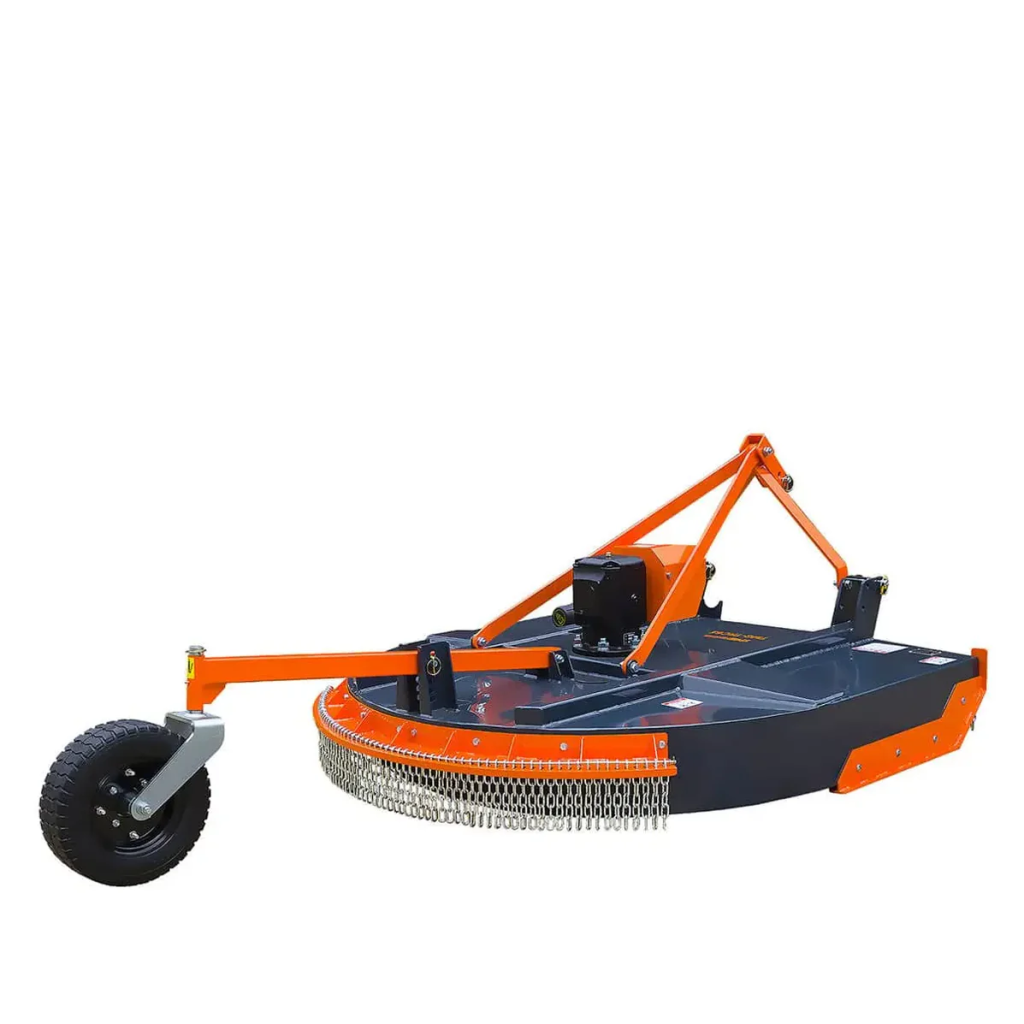
On Canadian acreages and pastures, summer is when neglected corners fill with saplings, briars, and waist-high weeds that a lawn deck cannot touch. Clearing them calls for an implement built around mass and durability rather than a fine finish.
That distinction is the whole reason the rotary cutter exists as a separate class of mowing tool.
Free-Swinging Blades Trade a Clean Finish for Survival
Under the deck of a rotary cutter sit heavy blades bolted to a spinning stump jack, but they are not fixed rigidly. Each blade pivots on its bolt, free to swing back when it strikes something it cannot cut.
Meet a boulder or buried iron and the blade folds rather than shattering or twisting the shaft, then centrifugal force flings it straight again for the next stem. The pivot exists to survive impact, not to leave a manicured lawn.
Because the blades are not rigid, a rotary cutter shrugs off the hidden hazards of rough ground that would bend a fixed knife or crack a spindle.
Mass and Tip Speed Are What Fell Woody Stems
A rotary cutter does its work through momentum. The blades are thick and heavy, and at full speed their tips move fast enough to slice through green saplings up to two inches thick.
Rather than parting the stalk like a knife, the blunt heavy edge tears through it in one blow. That is why the cut looks rough, and why the same machine that would ruin a lawn thrives in a brush lot.
Contractors clearing fence lines and reclaiming overgrown lots lean on this brute approach every summer.
Guards and Chains Keep the Cut Material from Becoming a Hazard
Blades turning that fast will throw anything they strike, from stones to broken wood. A rotary cutter surrounds the blade path with a steel deck and often a skirt of chains or rubber along the open edges.
Those deflectors pin debris downward and inside the housing rather than launching it toward people or property. Treating the guard as optional is one of the more dangerous habits in the field.
On roadside and ditch work, where gravel and bottles lurk in the grass, that containment is the difference between a routine pass and a broken windshield nearby.
- Steel deck: contains most thrown fragments
- Chain skirt: blocks debris at the open edge
- Downward discharge: keeps material near the ground
- Clear bystanders: nobody within the throw radius
A Slip Clutch Saves the Driveline from Sudden Shocks
Heavy brush hides stumps and hidden iron, and a blade that grabs one sends a violent jolt back through the shaft. The slip clutch on a rotary cutter is a pair of friction plates set to slip once torque climbs past a safe limit.
When the blade stalls against something solid, the clutch slips and absorbs the spike instead of shearing a gearbox or twisting the driveline. It is cheap insurance against the one obstacle the operator never saw.
- Friction plates: slip past a set torque
- Shock absorption: protects gearbox and shaft
- Adjustable tension: tunes the slip point
- Routine check: keep the plates dry
Every part of the design points the same way, toward surviving abuse rather than grooming a surface. Blades that swing, guards that contain, and a clutch that yields all serve durability first.
For land that summer has let run wild, a rotary cutter remains the implement built to bring it back under control.